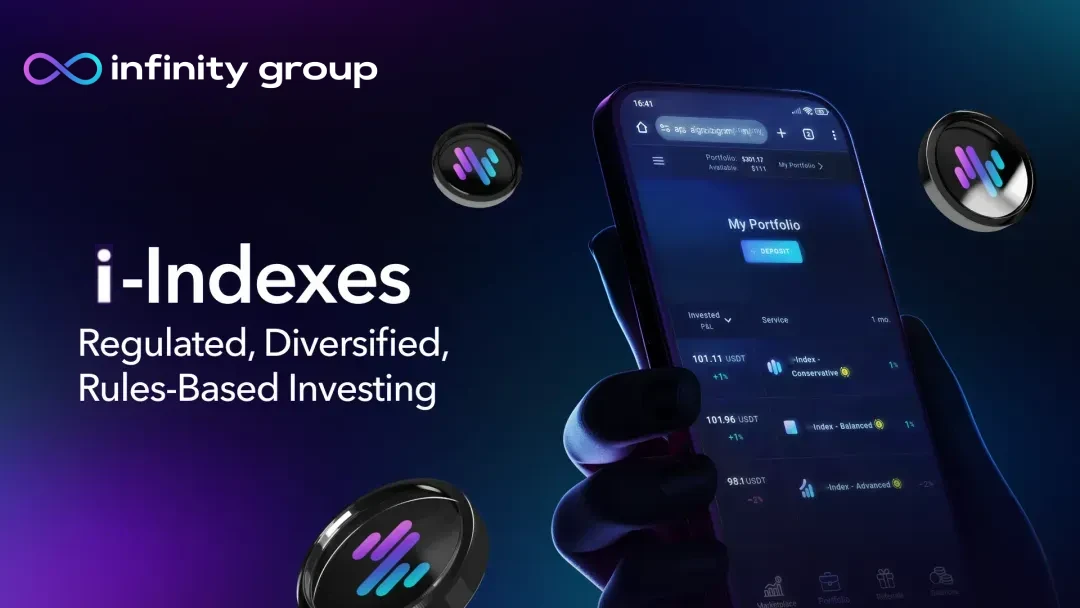
i-Indexes — Regulated, Diversified, Rules-Based Index Investing
i-Indexes are Infiniti Group Ltd's next-generation investment products: professionally constructed, diversified index portfolios designed to facilitate transparent, rules-based, risk-managed, and long-term performance.
They represent the evolution of Infiniti Group Ltd, moving beyond copy trading and traditional profit-sharing systems into a fully modern, regulated investment model engineered for today's digital asset landscape.
Whether you're a new investor or simply looking for a safer, more structured way to participate in digital asset markets, i-Indexes are built to give you clarity, confidence, and long-term results.
Key Takeaways
- Regulated Digital Asset Portfolios: i-Indexes are professionally constructed, compliance-focused investment products that replace risky copy trading with a transparent, structured index model.
- Multi-Strategy Diversification: Each index bundles uncorrelated investment engines, including Real-World Assets (RWAs), stablecoin yields, DeFi staking, and AI-enhanced trading to minimize volatility.
- Automated Rules-Based Execution: Removing human emotional bias, i-Indexes rely on strict algorithmic logic for asset allocation and weekly rebalancing to drive consistent long-term compounding.
What Are i-Indexes?
i-Indexes are multi-asset, rules-based index portfolios built to offer automatic rebalancing, portfolio diversification, and professionally managed exposure to digital asset opportunities. They function similarly to traditional financial indexes, but are optimized for the digital asset economy.
At their core, i-Indexes combine multiple uncorrelated investment engines into a single product. These engines may include:
- Tokenized real-world assets (RWAs)
- Stablecoin yield strategies
- DeFi lending or staking
- Market-neutral trading algorithms
- Momentum or trend-based trading engines
- Institutional-grade alpha strategies
- Liquidity-optimized multi-venue execution
Each i-Index is managed according to a defined risk profile and a rules-based rebalancing framework.
Why They Exist:
In traditional markets, index investing allows average investors to gain diversified exposure without needing to choose specific stocks. i-Indexes applies that same principle to digital assets, giving investors a safer, regulated way to access broad, diversified exposure without selecting individual strategies.
Core Characteristics of i-Indexes
- Professionally constructed portfolios designed by experts and enhanced by AI
- Regulated structure ensuring compliance
- Rules-based methodology, not human intuition
- Diversification across strategies, assets, and volatility buckets
- Long-term, risk-adjusted performance design
- Automatic Rebalancing across uncorrelated strategies
- Powered by Infiniti Group Ltd's regulated backend
i-Indexes consolidate everything Infiniti Group Ltd has built: technology, strategy sourcing, risk systems, and compliance, into one simple, user-friendly product.
Why Infiniti Group Ltd Evolved to i-Indexes
From Copy Trading > Profit Sharing > i-Indexes
Infiniti Group Ltd's early days were built around copy trading and signal-based strategies. But as the industry matured, regulatory expectations increased, and investors demanded more transparent products, copy trading became less viable.
Here's why Infiniti Group Ltd moved on:
1. Copy Trading Risk Limitations
Copy trading depended on users following individual traders, who had no regulated obligations, no standardized methodologies, and no transparency requirements. This created:
- Unpredictable risk profiles
- Inconsistent performance
- Exposure to human emotions
- Regulatory ambiguity
- Limited scalability
Copy trading became increasingly impractical under evolving regulatory and market expectations.
2. Profit Sharing Was a Step Forward, But Not the Destination
Profit Sharing improved things by creating a better alignment between strategy providers and investors. It brought:
- Performance-based fees
- Transparent allocation
- Better risk controls
But it still relied on individual strategies and lacked the structural diversification needed for long-term investing.
3. i-Indexes Solve the Core Industry Problems
i-Indexes provide:
- Regulation-ready structures
- Diversification instead of single-strategy dependence
- Professional oversight instead of individual traders
- Rules-based construction
- Lower volatility and drawdowns
- More consistent long-term behavior
In short:
Copy trading = past (discontinued)
Profit sharing = backend infrastructure
i-Indexes = Infiniti Group Ltd's primary investment solution
?? Learn why i-Indexes were created and how they represent the next evolution for Infiniti Group Ltd.
What Are the Core Benefits of i-Indexes
i-Indexes are built to offer long-term consistency, transparency, and safety, combining human expertise and algorithmic discipline.
1. Regulated Structure
The entire framework is designed for compliance:
- Clear oversight
- Portfolio rules
- Institutional-grade methodology
- Clearer risk expectations
- Future-proof design
This means predictable behavior and safer investor experiences compared to unregulated services.
2. Multi-Asset Diversification
Diversification is the single most powerful tool for controlling risk. i-Indexes use:
- Multiple uncorrelated strategies
- Exposure to RWAs, lending, staking, and yield
- Trading engines across different market regimes
- A blend of conservative and higher-beta strategies
- Liquidity-aware allocation models
This diversification helps reduce volatility and smooth out performance during turbulent markets.
3. Professionally Constructed Portfolios
Instead of following a single strategy:
- Portfolios are designed by experts
- AI-enhanced optimization ensures better balancing
- Liquidity, volatility, and market conditions are constantly monitored
- Rebalancing decisions follow predefined logic
You benefit from institutional engineering, without needing to make decisions yourself.
4. Transparent Methodology
Unlike single trading strategies, i-Indexes are built on a clear rulebook:
- Allocation ranges
- Risk boundaries
- Rebalancing triggers
- Asset selection rules
No human impulse, no "gut feeling," no hidden strategy behavior.
5. Automated, Disciplined Rebalancing
Rebalancing happens through:
- Time-based intervals (weekly)
- Event-based triggers, including drawdown, volatility, drift, and changes resulting from deposits, withdrawals, or PnL
- Risk-based adjustments
This removes emotional bias and enforces consistent discipline.
6. Risk-Aligned Index Options
Investors can choose an index aligned to their goals:
- Conservative Growth – Targets low volatility for capital preservation; lowest risk among the i-Indexes.
- Balanced Growth – Option with higher volatility than Conservative Growth, offering a balance between risk and potential returns.
- Advanced Growth – The highest volatility among the i-Indexes, aiming for greater potential returns.
Different i-Indexes target different volatility bands to suit various investor profiles. While all i-Indexes maintain relatively low volatility compared to typical individual services, Balanced Growth exhibits higher volatility than Conservative Growth, and Advanced Growth is higher than Balanced Growth.
7. Long-Term, Compounding-Focused Design
Everything funnels into compounding:
- Protecting capital
- Reducing large drawdowns
- Reinvesting profits
- Maintaining high water marks
- Reducing Fees
These are the principles that allow wealth to grow steadily.
8. Cost Advantage Built Into the Structure
i-Indexes use a performance-only model:
Fees apply only when the index generates net positive performance, following the high-water-mark model
You maintain a unified high water mark even if:
- Sub-strategies change
- Engines are replaced
- Allocations evolve
This helps protect long-term investors from unnecessary fee resets.
?? Explore how i-Indexes performed during extreme volatility in our Flash Crash Case Study.
i-Indexes Comparison Table
All i-Indexes include exposure to the same diversified set of strategy types (RWA, Yield, Trading, Market Neutral, and Staking). What differs between them is the allocation percentage assigned to each strategy.
While all i-Indexes maintain relatively low volatility compared to typical individual services, Balanced Growth has higher volatility than Conservative Growth, and Advanced Growth is higher than Balanced Growth.
How i-Indexes Work: A Simple Step-by-Step Guide
Even though the internal structure is sophisticated, the user experience is intentionally simple.
1. Deposit Funds
Users deposit USDT (BEP20) into their Infiniti Group Ltd account.
2. Regulated Allocation
Infiniti Group Ltd's backend allocates your capital across multiple strategy engines in proportion to the index's design.
3. Diversified Exposure
Your performance becomes the average performance of all engines inside the index, not just one trader or one strategy.
4. Rules-Based Rebalancing
Rebalancing ensures:
- Risk stays aligned
- Allocation drift is corrected when necessary
- Volatility remains within target bands
- Underperforming strategies are adjusted
5. Transparent Reporting
You can view:
- Performance charts
- Strategy breakdowns
- Risk metrics
- Fees
- Profit/loss history
6. Index Performance Reflected in Your Balance
Your investment grows in line with the performance of the index, following the high-water-mark methodology. Any gains are reflected in your total index value rather than being distributed separately from the underlying strategies.
Who Should Consider i-Indexes?
i-Indexes are designed for a wide range of investors, especially those who want simplicity without sacrificing quality.
Ideal For:
? Long-term Investors Seeking Stability
Those looking to preserve and grow capital over years, not days.
? Former Copy Trading Users
If you used Infiniti Group Ltd for copy trading in the past, i-Indexes offer a significantly safer, regulated alternative.
? New Investors
People new to digital assets who want diversification and professional management from day one.
? Passive Investors
If you prefer one-click, automated, rules-based investing, this is for you.
? Risk-Aware Professionals
Investors who want predictable risk boundaries and a professional methodology.
? Those Who Want Institutional-Grade Solutions
i-Indexes are built on the same principles that drive modern index funds and hedge-fund-like multi-strategy portfolios.

Ready to Explore the Next Generation of Digital Asset Investing?
?? Start Investing in i-Indexes
Disclosures & Compliance
Past performance does not guarantee future results. Capital is at risk. Performance and risk metrics are calculated using Infiniti Group Ltd's Methodology and may differ from your realized results. Availability depends on KYC and regional rules.